Tumbling Mom SVG: A Designer’s Real-World Embroidery Review
As a designer who’s stitched hundreds of custom pieces—from boutique baby onesies to holiday aprons for local craft fairs—I opened the Tumbling Mom SVG file with quiet curiosity, not hype. I wasn’t looking for “cute.” I was asking: Will this hold up under needle and thread? Will my client smile when they see it stitched on their tote bag—and will it still look intentional after three washes?
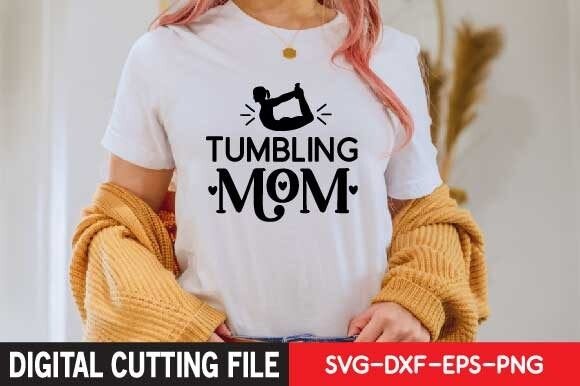
The first impression is warm, playful, and grounded—not overly whimsical or cutesy. The lettering has gentle curves and balanced spacing; the “tumbling” motif suggests motion without chaos. It reads as joyful but not childish—perfect for a mom who’s equal parts organized and delightfully unpolished. That tone matters. A design like this doesn’t belong on a stiff corporate polo—it belongs on a soft cotton sweatshirt, a linen tea towel, or a twill patch sewn onto a denim jacket.
I tested Tumbling Mom SVG as the centerpiece for a custom embroidered canvas tote—a common small shop product for Mother’s Day. The layout scaled cleanly to 4.25 inches wide, fitting comfortably inside a standard 5x7 hoop. No crowding. No awkward truncation. The curves stayed smooth, the negative space between letters allowed breath—critical for fill stitch clarity. On medium-weight canvas with tear-away stabilizer, the satin-stitched outlines held crisp definition, while the interior fills stayed dense enough to avoid fabric show-through but light enough to drape naturally.
This isn’t just a T-Shirt Designs graphic repurposed for embroidery—it behaves like a design that *understands* stitch. There are no ultra-thin serifs or hairline gaps that vanish mid-stitch. No overlapping letters that risk thread nesting. Even the lowercase “g” and “y” have open counters—no trapped thread, no skipped stitches on my Brother PR1050X. That’s rare in SVG-to-embroidery conversions, and it tells me whoever prepared this file respected the medium.
Where Tumbling Mom SVG shines brightest is in context-driven projects: personalized gifts and small-batch merchandise. Think baby embroidery on a gauzy receiving blanket (use lightweight cutaway stabilizer), holiday embroidery on a flannel pillow cover (reduce fill density slightly for softness), or a boutique-branded apron for a local café (pair with muted thread colors—olive, charcoal, oatmeal—for timeless appeal). It also works surprisingly well as an embroidered patch—clean edges, moderate stitch count, and strong visual hierarchy make it legible at 3 inches.
But let’s talk where to pause. This design isn’t ideal for tiny hoops (<4 inches) without simplification—some inner curves tighten near the “b” and “m,” and those details can blur on dense fabrics like fleece or thick terry cloth. On stretchy knits (think ribbed baby bodysuits), you’ll need excellent stabilization—ideally a combination of cutaway + topping—to keep letterforms from distorting during stitching. And on dark fabric? Test your thread contrast early. Light tan or cream thread reads beautifully on navy or charcoal—but pale yellow disappears on black unless you add a subtle underlay stitch (check your embroidery software settings).
I also ran it through a few practical filters: Does it scale down for a cap front? Yes—but only to ~3.5 inches. Below that, the “tumbling” curve loses its charm. Does it work on curved surfaces like baseball caps? With proper cap framing and reduced density, yes—but avoid placing it directly over the seam ridge. Does it translate well to printable mockups for Etsy listings? Absolutely. Its balanced proportions and clear silhouette pop in both light and dark background previews—no guesswork for buyers scrolling on mobile.
For Etsy sellers and craft fair vendors, Tumbling Mom SVG adds quiet professionalism to handmade product listings. It doesn’t scream “discount clipart.” It feels curated—like part of a cohesive collection rather than a one-off graphic. Customers notice that. When a mom unwraps a personalized sweatshirt with this design stitched cleanly on the chest, she doesn’t just see text—she sees care. That perception lifts perceived value, builds trust, and encourages repeat orders.
A few non-negotiable notes before you stitch:
- Always test on scrap fabric first—especially if using textured or loosely woven material.
- Review stitch density in your embroidery software. High-density fills may pucker delicate fabrics; reduce by 10–15% for baby items or lightweight linens.
- Confirm hoop size compatibility before digitizing or purchasing—this file is versatile, but your machine’s limits define what’s realistic.
- Inspect small corners and curves in your preview mode. Look for stacked stitches or abrupt direction changes that could cause thread breaks.
- Test in black-and-white mockups—it reveals contrast issues faster than color screens.
- Use appropriate stabilizer: cutaway for knits, tear-away for stable wovens, fusible + topping for napped fabrics like towels.
- Verify licensing before selling finished products or digital embroidery files—this is an instant-download cutting file, so commercial use terms depend on the seller’s policy.
Ultimately, Tumbling Mom SVG earns its place in a working designer’s library because it bridges intention and execution. It’s not flashy—but it’s reliable. Not trendy—but it’s enduring. It fits seamlessly into real embroidery projects: the baby onesie gifted at a baby shower, the apron worn at a farmers’ market stall, the tote bag carried to preschool pickup. It doesn’t ask to be the hero of the garment—it asks to belong there, thoughtfully, warmly, and well-stitched.
If you’re curating design assets for your craft business—or choosing a graphic that represents your brand’s voice—Tumbling Mom SVG isn’t just another Graphics download. It’s a quiet promise: that your handmade product will land with clarity, charm, and craftsmanship.