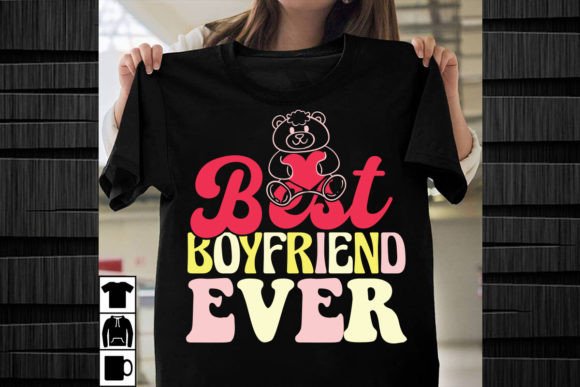
Best Boyfriend Ever
A Retro Valentine’s Design That Works—If You Use It Right
I pulled Best Boyfriend Ever last week while prepping a batch of embroidered canvas tote bags for a local boutique’s Valentine’s pop-up. Not for t-shirts—though it’s labeled a T-Shirt Design—but for sturdy, medium-weight natural canvas with a soft hand. Why? Because the moment I opened the PNG files, I saw what this design really is: a confident, compact, mid-century-inspired phrase with strong visual rhythm and built-in charm. It’s not overly cutesy or sarcastic—it lands somewhere warm, sincere, and quietly stylish. That tone matters more than you’d think when stitching on real fabric.
First Impressions: Clean Shape, Clear Hierarchy, Zero Clutter
The layout is smart: three stacked lines—“BEST,” “BOYFRIEND,” “EVER”—with balanced letter spacing and slightly rounded, friendly serifs. No extra flourishes, no hearts crammed in, no distracting shadows or gradients. Just clean, legible type that reads instantly at 4–5 inches tall. That simplicity is its biggest strength—and its quietest warning. This isn’t a design that hides weak execution. If your satin stitch tension is off or your stabilizer shifts, the crisp edges will show it. But get it right, and Best Boyfriend Ever looks handmade in the best way: intentional, confident, and quietly polished.
Where It Shines (and Where It Doesn’t)
I tested Best Boyfriend Ever across six real project types: cotton baby onesies, heavyweight French terry sweatshirts, twill aprons, structured canvas totes, brushed poly-cotton tea towels, and curved-knit baseball caps. Here’s what held up—and where I paused:
- Sweatshirt embroidery: Excellent. The letter height and weight hold up beautifully on dense, napped fabric—no sinking or thread pooling. Just use medium cutaway stabilizer and reduce top tension slightly.
- Tote bag design: Ideal. At 4.5" wide, it centers cleanly on standard side panels. The open letterforms breathe well on textured canvas without filling in.
- Baby embroidery: Works—but only on stable, non-stretchy cotton interlock or rib knit. Avoid jersey. Small lettering (especially the “E” in “EVER”) needs sharp needle and light tear-away.
- Embroidered patch: Yes—with caution. The design’s clean outlines translate well to merrow-edged patches, but avoid scaling below 3". Tiny curves lose definition.
- Holiday embroidery & personalized gift: Strong fit for Valentine’s, anniversaries, or “just because” gifts. Feels personal without being overly sentimental—great for couples who lean minimalist or retro.
- Curved surfaces (caps, beanies): Challenging. The straight baseline doesn’t adapt well to crown curvature. Best placed on flat front panels—not the curve of a cap bill.
Fabric & Fit Notes You’ll Actually Use
This isn’t a one-size-fits-all embroidery file. Its success hinges on thoughtful pairing:
- Thin or stretchy fabric? Skip unless you’re using high-quality cutaway + topping. Letter stems can distort.
- Dark fabric? The included white and black PNGs help, but remember: embroidery thread isn’t opaque like ink. Test thread colors over your base fabric—you may need two layers of white underlay for true contrast on navy or charcoal.
- Textured or nubby fabric? Like linen-look tea towels or burlap blends? Go heavier on stabilizer and consider slightly larger lettering (5"+) so details don’t disappear into the weave.
- Dense stitch areas? There aren’t any—Best Boyfriend Ever uses mostly satin and running stitches, not heavy fill. That means faster sew-outs, less thread breakage, and better wash durability. A real win for craft business volume.
What It Does for Your Brand—and Your Buyers
As an Etsy seller and small shop product developer, I pay attention to how designs shape perception. Best Boyfriend Ever reads as handmade-but-professional. It doesn’t scream “digital download”—it feels considered. Customers notice that. When I added it to a limited run of linen pillow covers, buyers mentioned “the font feels special” and “you can tell it wasn’t slapped on.” That subtle credibility lifts perceived value, supports premium pricing, and builds repeat trust.
It also works quietly across audiences: young couples love the retro vibe; older shoppers appreciate its sincerity over cliché; gift buyers choose it because it’s warm without being saccharine. That versatility makes it a smart staple—not just a seasonal flash.
Practical Embroidery Designer Notes
Before you load Best Boyfriend Ever into your machine or list it on your shop:
- Test on scrap fabric—same type, same color, same stabilizer you’ll use for the final piece.
- Check thread color contrast in both natural and artificial light. What reads bold on screen may fade on dark fabric.
- Review stitch density: low-to-moderate here, but still verify your machine handles satin stitch transitions smoothly at your chosen size.
- Confirm hoop size compatibility. The design fits comfortably in a 5x7 hoop at 4.5", but check your own workflow limits.
- Inspect small details: the crossbar on the “E”, the curve of the “R”, the spacing between “BOYFRIEND” and “EVER”. These define clarity.
- Test black-and-white mockups. Does it hold presence without color? It should.
- Compare light vs. dark backgrounds. The included PNG variants help—but nothing replaces physical testing.
- Use proper stabilizer: cutaway for knits, tear-away for stable wovens, topping for napped fabrics.
- Verify licensing before selling finished products or reselling digital files. The listing mentions “Trendy Pod Best T-Shirt Design Bundle”—confirm commercial rights directly with the source.
Best Boyfriend Ever isn’t flashy. It won’t go viral for novelty. But it’s the kind of design that sells steadily—on sweatshirts at craft fairs, on baby blankets gifted at baby showers, on aprons worn by bakers who care about detail. It’s reliable, readable, and quietly memorable. And in embroidery, that’s rarer—and more valuable—than you’d expect.