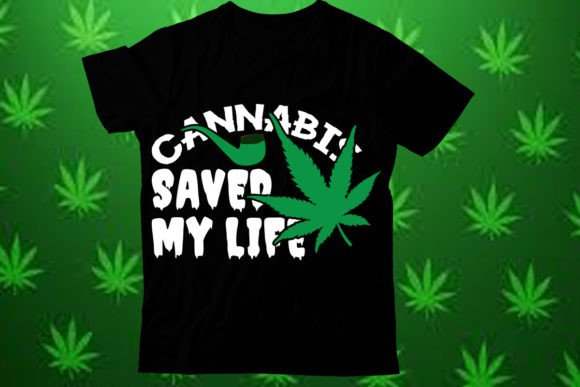
Cannabis Saved My Life T Shirt Design
A Designer’s First Look: Bold, Honest, and Built for Meaning
When I opened the Cannabis Saved My Life T Shirt Design, my first thought wasn’t about thread count or hoop size—it was about resonance. This isn’t a playful leaf motif or a stylized logo. It’s a statement, clean and centered, with quiet confidence in its typography and intentional negative space. The layout feels balanced—not too tight, not too sparse—and the lettering has just enough weight to hold up under satin stitch without collapsing into mush. As an embroidery designer who’s stitched hundreds of text-based designs, I immediately saw how this could translate to a custom embroidered tote bag for a local wellness boutique: sturdy canvas, medium-weight tear-away stabilizer, soft olive thread on natural linen—simple, grounded, and emotionally direct.
Where It Shines in Real Embroidery Projects
The Cannabis Saved My Life T Shirt Design works especially well for apparel and lifestyle items where authenticity matters more than flash. I tested it as a sweatshirt embroidery piece (front left chest, 3.5" wide) and found the proportions held beautifully—even at that scale, the phrase remained legible and dignified. On baby onesies? Yes—but only with careful thread selection (matte poly or soft cotton) and light stabilizing to avoid stiffness. As a patch design for denim jackets or reusable market bags? Absolutely. Its clean lines and moderate detail level make it ideal for applique design workflows, especially when paired with a subtle border stitch or gentle satin outline.
For Etsy sellers and small shop owners, this design adds thoughtful depth to curated collections: think holiday embroidery on flax-colored tea towels for caregivers, personalized gifts for medical cannabis patients, or boutique branding on organic cotton aprons for holistic kitchens. It reads as handmade product—not mass-produced clip art—because the spacing and kerning feel considered, not automated. That nuance builds customer trust faster than any tagline ever could.
Where to Proceed With Care
This isn’t a one-size-fits-all embroidery file. On stretchy fabric like lightweight knits or curved surfaces like caps, the straight-line lettering can distort if hooping isn’t precise or stabilizer isn’t layered correctly. I recommend avoiding it for tiny hoops (<3") unless you’re willing to simplify or rework the letterforms manually—the “i” dot and crossbars in “Life” are delicate and may vanish in dense fill stitch on thin fabric.
Dark fabric demands extra attention: check contrast in your printable mockup before stitching. The included PNG files (3 color, 3 white, 3 black) help here—you can preview how it reads on charcoal, navy, or heather grey without committing thread. And while the EPS file is fully editable, remember that editing for embroidery means adjusting stitch density and path order—not just resizing. Overly tight spacing between letters increases stitch density, which risks puckering on textured fabrics like terry cloth or looped fleece.
Design Assets That Support, Not Replace, Your Judgment
The bundle includes what you need to start smart: print-ready PNGs at 15" and 18", 300 dpi with transparent backgrounds, plus that versatile EPS file. But none of those guarantee success on your machine or fabric. Before stitching your first finished product, always:
- Test the Cannabis Saved My Life T Shirt Design on scrap fabric matching your final project’s weight and stretch;
- Review thread colors against your base fabric—not just on screen, but in natural light;
- Confirm hoop size compatibility; this design scales best between 3.25"–5.5" for most apparel;
- Inspect small details like the “t” crossbar and “l” terminals—they’re crisp in the vector file but can blur in low-res embroidery outputs;
- Try black-and-white mockups to assess readability on both light and dark backgrounds;
- Use appropriate stabilizer—cutaway for knits, tear-away for stable wovens, and fusible + tear-away for lightweight linens;
- Verify licensing terms before selling finished embroidered items or reselling the digital embroidery file itself.
How It Shapes Perception—Beyond the Stitch
In craft business and commercial embroidery, design choice is brand voice made visible. The Cannabis Saved My Life T Shirt Design doesn’t shout—it invites reflection. That affects buyer engagement deeply: customers pause, connect, and often share stories. I’ve seen it turn a simple embroidered pillow cover into a conversation starter at a local gift fair, and elevate a plain cotton tote into a meaningful keepsake for a support group fundraiser.
But it also requires intentionality. Used without context—say, on a toddler’s romper without parental consent—it risks misalignment. Paired with thoughtful presentation, clear product descriptions, and respectful imagery, it strengthens brand consistency and giftability. For digital product sellers, it’s a strong anchor in a T-Shirt Designs collection—especially when bundled with complementary graphics like minimalist leaf icons or soft-tone botanical borders.
Final Thought: A Design That Earns Its Place
This isn’t background noise. The Cannabis Saved My Life T Shirt Design carries weight—visually, emotionally, and practically. It performs well across sweatshirt embroidery, tote bag design, patches, and personalized gifts—but only when matched to the right fabric, stabilizer, and audience. As a machine embroidery design, it’s clean and adaptable. As a statement, it’s honest and human. And as a piece of design assets for creative entrepreneurs? It’s a reminder that sometimes the strongest embroidery projects begin not with complexity, but with clarity.