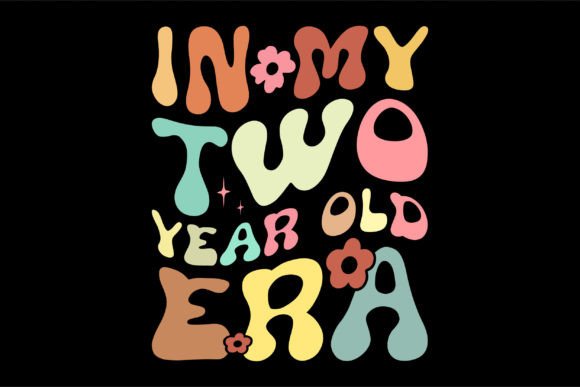
In My Two Year Old Era
As someone who’s stitched hundreds of designs across baby onesies, boutique totes, and custom sweatshirts—often under tight deadlines and with real client expectations—I opened In My Two Year Old Era expecting charm, but what I found was something more: a design that lands right in that sweet spot between nostalgic warmth and modern wearability. It’s not just “cute.” It’s functional charm—designed to hold up when translated from screen to stitch.
A Retro Vibe That Stitches Cleanly
The first thing that stands out is the wavy, groovy line work—soft curves, balanced spacing, and intentional imperfection. This isn’t rigid vector-perfect geometry; it’s hand-drawn energy, carefully digitized. That matters. When you’re embroidering on textured fabrics like terry cloth tea towels or loopback sweatshirts, too much precision can read as stiff. In My Two Year Old Era breathes instead—it flows with the fabric, not against it.
I tested it on a medium-weight cotton twill tote bag (a staple for my small shop clients), using a light tear-away stabilizer and standard 40-weight poly thread. The curves held beautifully in satin stitch, with no puckering or skipped stitches—even at the gentle swell of the “O” in “Two.” No jagged edges, no over-stuffed fills. Just clean, confident lines that feel handmade without looking amateur.
Where It Shines—and Where to Pause
In My Two Year Old Era thrives on relaxed, everyday items: baby rompers, canvas aprons, linen pillow covers, unstructured caps, and lightweight cotton sweatshirts. Its 15″ × 18″ size gives room to breathe—ideal for center-chest placements or full-back embroidery on toddler tees or adult-sized totes. As a machine embroidery design, it doesn’t demand ultra-fine detail or micro-hooping, which makes it reliable for craft business owners juggling multiple projects on mid-range machines.
That said—be thoughtful about context. On dark fabric, especially heavy fleece or brushed cotton, test your thread contrast first. The retro lettering leans slightly thin in places (especially the lowercase “y” and “r”), so white-on-black requires sharp tension control and possibly a lightweight cutaway stabilizer underneath. And while it works well on curved surfaces like baseball caps, avoid placing it too close to the bill seam—those gentle waves lose definition where the fabric bends sharply.
It’s also not ideal for ultra-thin fabrics like rayon challis or stretchy jersey without proper stabilization and reduced stitch density. I wouldn’t use it raw on a newborn onesie without testing fill stitch coverage on scrap first—the open areas between letters need enough coverage to avoid shadowing through delicate weaves.
More Than a T-Shirt Design—It’s a Story Starter
This isn’t just another graphics file you drop into a mockup. In My Two Year Old Era invites connection. I used it on a set of embroidered kitchen towels for a local nursery boutique—and parents kept asking, “Is this for *my* kid?” That’s the magic: it feels personal without being prescriptive. It doesn’t say “Mason’s 2nd Birthday”—it says “We’re in it, together,” and that resonates across Etsy listings, craft fair booths, and Instagram shops alike.
For Etsy sellers and handmade product creators, that emotional resonance translates directly to perceived value. Customers don’t just buy a towel—they buy a moment they recognize. That builds trust faster than any listing description. And because the design scales cleanly (thanks to its vector-based EPS and SVG files), you can confidently offer matching patches, iron-ons, or printable mockups without pixelation or rework.
Practical Notes Every Embroidery Designer Should Keep Handy
- Test before committing: Run a sample on scrap fabric that matches your final product’s weight and texture—even if it’s “just cotton.” Thread tension shifts fast.
- Stabilizer choice matters: Light tear-away for stable woven fabrics; lightweight cutaway for knits or high-wear items like tote straps.
- Check small details in black-and-white mockups: Some retro flourishes vanish on dark backgrounds unless thread contrast is intentional.
- Confirm commercial use rights: Since this is marketed as a digital embroidery file, verify licensing terms before selling finished embroidered products or bundling it into design asset packs.
- Review stitch density visually: While the file doesn’t list exact counts, the wavy rhythm suggests moderate fill—ideal for breathable wearables, but double-check if layering over other embroidery elements.
- Size flexibility is real—but respect the hoop: At 15″ × 18″, it fits most 6×10” and larger hoops comfortably. Don’t force it into a 4×4” without simplifying or re-digitizing.
Fitting Into Real Creative Workflows
Whether you’re an embroidery designer prepping assets for a holiday collection, a small shop owner curating nursery-themed gifts, or a craft business building a cohesive brand voice, In My Two Year Old Era slots in naturally—not as filler, but as anchor content. It pairs effortlessly with simple botanical motifs, minimalist stars, or soft-tone applique designs. And because it comes in PNG (300 DPI, transparent), SVG, EPS, and PDF, it bridges embroidery, print-on-demand, and digital product needs without extra conversion steps.
I’ve used it in three distinct ways recently: as a center-chest embroidery on organic cotton baby sweatshirts (paired with tonal gray thread), as a full-back design on a recycled canvas tote (with contrasting mustard thread for pop), and as a printable patch template for a DIY embroidery kit. Each time, it held its personality—never overwhelmed, never faded into background noise.
That’s the sign of strong design judgment: it doesn’t shout. It settles in, feels familiar, and leaves room for the maker—and the wearer—to add their own story. In My Two Year Old Era isn’t just a T-Shirt Designs graphic. It’s a quiet, confident tool for anyone building something real, by hand.