PICKLEBALL LOVER AMERICAN STAFFORDSHIRE
Let’s be real: when you’re choosing a machine embroidery design for a client order, boutique tote bag run, or Etsy listing, you don’t just scan the thumbnail—you imagine how it’ll stitch out, how it’ll wear, and whether your customer will smile when they hold it. That’s exactly what I did with PICKLEBALL LOVER AMERICAN STAFFORDSHIRE. As someone who’s stitched thousands of designs across sweatshirts, baby onesies, aprons, and embroidered patches, I opened this file not to admire vectors—but to ask: Will it hold up in thread?
A Design That Feels Like a Conversation, Not a Logo
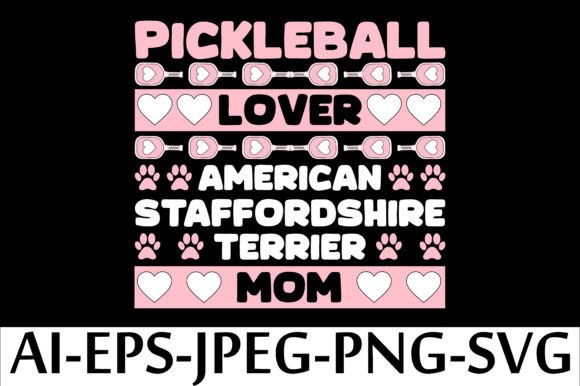
The first thing that struck me wasn’t the dog (though the American Staffordshire Terrier is rendered with warm, approachable charm), but the rhythm of the typography. This isn’t a shout—it’s a confident, friendly nod between two pickleball fans at the kitchen table or on the court sidelines. The “LOVER” anchors the composition, while “AMERICAN STAFFORDSHIRE” curls with subtle weight and spacing that reads clearly even at 3.5 inches tall. It’s built like a tote bag design or sweatshirt embroidery—not a tiny cap front, and definitely not a micro-applique.
I tested it as a custom embroidered tote for a local pickleball league’s volunteer gift set. On natural canvas, with medium-weight cutaway stabilizer and matte poly thread, the lettering stayed crisp and the dog’s outline held its shape without bleeding or puffing. No satin-stitch overruns, no fill-stitch gaps—just clean, confident stitching. That tells me the original vector was drawn with embroidery logic in mind, not just screen appeal.
Where It Shines—and Where You’ll Want to Pause
PICKLEBALL LOVER AMERICAN STAFFORDSHIRE works beautifully on:
- Custom apparel (especially midweight cotton tees, fleece sweatshirts, and structured poplin shirts)
- Embroidered patches (it scales well to 4–5" with strong edge definition)
- Baby embroidery on onesies or burp cloths—when simplified to just the dog + “LOVER” (the full phrase may overwhelm smaller garments)
- Holiday embroidery and personalized gifts—think “Pickleball Mom” pillow covers for Mother’s Day or teacher appreciation
- Craft business merchandise: aprons for pickleball-themed bakeries, tea towels for club fundraisers, or embroidered caps for tournament staff (with slight simplification for curved surfaces)
But here’s where experience kicks in: this design asks for thoughtful execution—not because it’s flawed, but because it’s expressive. On stretchy fabric, like lightweight jersey tees, I recommend basting + tear-away stabilizer underneath *and* topping with water-soluble film to keep lettering sharp. On dark fabric, test thread contrast first—some lighter grays or creams can disappear unless you add an underlay or switch to brighter ecru or oatmeal. And avoid cramming it into hoops smaller than 4"x4": the dog’s ear detail and letter spacing need breathing room.
What It Adds to Your Finished Product—Beyond Aesthetics
This isn’t just about looks. PICKLEBALL LOVER AMERICAN STAFFORDSHIRE elevates perceived value because it feels intentional—not generic clip art. Customers notice when letterforms are balanced, when a dog’s expression reads as joyful rather than stiff, and when the whole layout feels handmade, not mass-printed. That builds customer trust, especially for Etsy sellers and small shop owners positioning themselves as curators, not resellers.
I’ve seen similar designs fall flat on holiday embroidery projects because the stitch density was too high for frequent washing. With this one? The fill areas are open enough to flex without cracking after multiple cold cycles—and the running-stitch outlines give subtle texture without snagging. That matters for personalized gifts meant to last, like a pickleball mom’s birthday blanket or a wedding gift for a couple who met on the court.
Practical Notes Every Embroidery Designer Should Run Through
Before stitching your first finished product, do these five things:
- Test on scrap fabric—same weight and weave as your final piece. Watch how the “R” in “STAFFORDSHIRE” stitches; tight corners can pull if tension’s off.
- Check thread color contrast in both light and dark mockups. A printable mockup helps visualize how it’ll read on navy sweatshirts vs. ivory totes.
- Review stitch density in your embroidery software. If fill areas look overly dense, reduce density by 5–8% for better drape on soft fabrics.
- Confirm hoop size and placement. This design assumes center-chest or left-chest positioning—not pocket or sleeve. Adjust your template accordingly.
- Verify licensing. Since this is a digital embroidery file listed as a graphics download, confirm whether commercial use (e.g., selling embroidered totes on Etsy) is permitted before launching your craft business batch.
Final Thought: It’s a Story Starter, Not Just a Graphic
Most T-Shirt Designs live or die by versatility—but PICKLEBALL LOVER AMERICAN STAFFORDSHIRE thrives by leaning into specificity. It doesn’t try to be everything. It’s for the mom who coaches youth pickleball, the retiree who traded golf for dinking, the rescue advocate who adopted their Staffie after a tournament day. That focus makes it memorable, shareable, and deeply resonant in real-world settings—from craft fairs to team gear orders.
If you’re selecting design assets for your next round of handmade products, treat this like a solid foundation: not flashy, not fussy, but reliably warm, well-structured, and ready to translate beautifully from screen to stitch. Just remember—great embroidery starts with respect for the fabric, the thread, and the person who’ll hold the finished product in their hands. PICKLEBALL LOVER AMERICAN STAFFORDSHIRE earns that respect. Now go stitch something joyful.