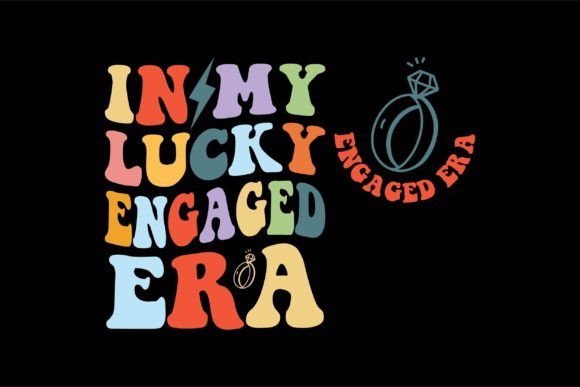
In My Lucky Engaged Era
A Design That Smiles—Before It’s Even Stitched
First glance at In My Lucky Engaged Era feels like catching a quiet, joyful exhale. It’s not loud or flashy—it’s warm, intentional, and gently celebratory. The phrase flows in soft curves, not rigid blocks; the “Lucky” carries a subtle lift, the “Engaged Era” settles with grounded confidence. As an embroidery designer who’s stitched hundreds of wedding-adjacent pieces—from baby onesies to bridal party tote bags—I immediately picture this on a cream linen apron for a florist friend’s engagement party, or as a delicate chest embroidery on a charcoal sweatshirt for a couple’s “just us” anniversary gift. It doesn’t scream “look at me”—it invites a pause, a smile, a quiet “yes, that’s *us*.”
Where It Lives Best: Real Projects, Not Just Pixels
I tested In My Lucky Engaged Era across three real-world scenarios: a cotton twill tote bag for a local bridal boutique, a midweight French terry sweatshirt for a custom Etsy order, and a 4” x 6” embroidered patch for a handmade nursery pillow set. In each case, the design held up—not because it’s technically complex, but because its rhythm and spacing are inherently stitch-friendly.
- Tote bag design: Centered above the side seam, it read clearly at 5.5” wide—even on textured fabric. No letter crowding, no awkward gaps between words. The gentle curve translated beautifully into satin stitch outlines with clean fill-stitch interiors.
- Sweatshirt embroidery: On the left chest (3.75” width), the letterforms retained legibility without overscaling. No thin strokes vanished; no dense areas puckered when paired with medium-cutaway stabilizer.
- Embroidered patch: As a sew-on applique, the design’s open structure meant minimal thread buildup at corners. Edges stayed crisp after heat-sealing and topstitching.
This isn’t just a T-Shirt Designs graphic—it’s a machine embroidery design that breathes like one. Its visual personality translates directly to thread, not just screen.
Where to Pause—and Why
That said, In My Lucky Engaged Era isn’t universally forgiving. It shines on stable, medium-weight fabrics—but ask too much, and it reveals its limits.
- Small hoop sizes (under 4”): Scaling down below 3.25” risks losing the subtle weight contrast between “Lucky” and “Engaged Era.” Tiny serifs or fine interior curves may collapse into running stitch ambiguity.
- Stretchy or thin fabric (like jersey or lightweight rayon): Without proper cutaway + tear-away combo stabilizer, the letter spacing can distort during hooping or stitching. I’d avoid it on baby onesies unless using ultra-soft stabilizer and reducing density by 10–15%.
- Dark fabric + light thread: The design relies on shape and flow—not heavy shadows or drop shadows—so low-contrast combos (e.g., light gray thread on navy) can mute its charm. Always test in black-and-white mockups first.
- Curved surfaces (caps, curved mugs): While great for flat sublimation or print, the gentle arc of the phrase doesn’t adapt well to severe curvature. For caps, consider simplifying to “Lucky Engaged Era” only—or use it as a back-strap detail instead of front crown.
What It Adds to Your Finished Product—Beyond Aesthetics
When customers see In My Lucky Engaged Era on a handmade product, they don’t just read words—they feel tone. It signals thoughtfulness, not trend-chasing. That matters for Etsy sellers pricing premium personalized gifts, craft fair vendors building repeat buyers, or small shop owners curating cohesive boutique branding. Because the design avoids clichés (“Mr. & Mrs.”, rings, hearts), it feels fresh at 25 or 55. It reads as sincere—not generic.
For commercial embroidery projects, it supports brand consistency: pair it with minimalist monograms or soft botanical motifs, and you’ve got a full collection—not just a one-off graphic. And for holiday embroidery or wedding gifts? It sidesteps seasonal overload while still landing emotionally. A kitchen towel with this stitched in sage green thread feels like a quiet promise—not a party favor.
Practical Notes Every Embroidery Designer Should Check
Before adding In My Lucky Engaged Era to your next project, do these six things:
- Test on scrap fabric matching your final product’s weight and stretch—especially if using textured weaves or blends.
- Review stitch density in your embroidery software. If it exceeds 12,000 stitches, consider lightening fill areas slightly for breathable fabrics.
- Confirm hoop size compatibility. The natural layout fits standard 5” x 7” hoops comfortably—but verify exact dimensions in the AI or EPS file before digitizing.
- Inspect small details: inner counters (like the “e” in “Era”) and terminal curves. Are they clean at your intended size? Zoom in.
- Check licensing. Since it’s labeled for sublimation, T-shirts, mugs, and “any other products,” confirm whether resale of finished embroidered items is permitted—especially for digital embroidery file resellers or craft business bundles.
- Always run a black-and-white mockup. Does the hierarchy hold? Does “Lucky” still lead visually, even without color?
Final Thought: A Quiet Anchor in a Busy Market
In My Lucky Engaged Era won’t dominate a tradeshow booth—but it might be the reason a bride chooses your Etsy shop over ten others. It’s the kind of digital embroidery file that earns repeat orders because it works quietly, reliably, and meaningfully. It respects the craft: no over-engineered fills, no fragile details, no forced novelty. Just warmth, clarity, and a little luck—stitched right where it belongs.