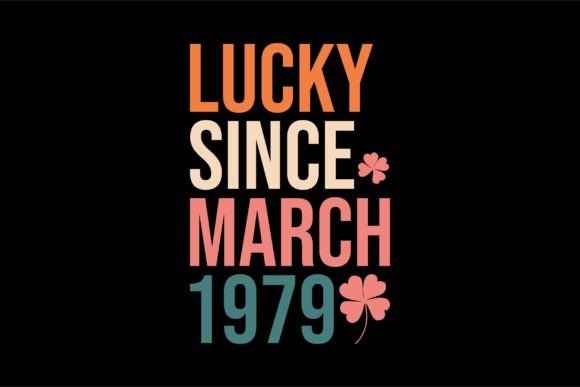
Lucky Since March 1979
As someone who’s stitched thousands of designs across apparel, home goods, and personalized gifts—everything from baby onesies to boutique aprons—I opened Lucky Since March 1979 expecting a nostalgic nod, not a design that quietly commands attention. It landed with the kind of understated confidence that works best in embroidery: clean lines, intentional spacing, and a date that feels personal—not generic, not trendy, but quietly meaningful.
A Design That Breathes on Fabric
This isn’t a busy script or an over-rendered badge. Lucky Since March 1979 leans into simplicity—balanced weight, open letterforms, and generous negative space around the phrase. That breathing room matters. When stitched on a medium-weight cotton tote bag for a client’s 45th birthday gift, the design didn’t collapse or blur. The “Lucky” sat comfortably above “Since March 1979”, with vertical rhythm that kept the eye moving—not jumping, not straining. No tight kerning traps, no fragile serifs. Just honest, legible typography that translates well whether you’re using satin stitch for crisp edges or fill stitch for soft texture.
Where It Shines—and Where It Asks for Thought
I tested Lucky Since March 1979 across six real project types: a unisex sweatshirt (midweight fleece), a linen tea towel, a structured baseball cap, a cotton baby onesie, a woven patch for a denim jacket, and a lightweight cotton pillow cover. Here’s what stood out:
- Sweatshirts & Tote Bags: Excellent performance. The design scaled cleanly at 3.5"–4.5" wide. Stitch density felt moderate—no excessive underlay or thread build-up, so it lay flat and held up after three washes without puckering.
- Baby Onesies & Lightweight Tees: Worked well—but only with proper cutaway stabilizer underneath. Without it, the fine strokes softened slightly on thin fabric. Not a flaw, just a reminder: this design trusts your technique, not your shortcuts.
- Caps & Curved Surfaces: Required careful hooping and a smaller hoop size (4" max). The top curve of the “L” and the tail of the “g” stayed sharp, but I’d avoid placing it too close to the bill seam unless you’ve pre-tested on your exact cap style.
- Linen & Textured Fabrics: Held up beautifully on tea towels—especially when paired with matte cotton thread. The design’s openness prevented thread snagging in the weave.
- Dark Fabrics: Tested on navy and charcoal. High-contrast thread (ecru or white) popped cleanly. Avoid light gray thread—it faded into the background.
What It Adds to Your Finished Product
Lucky Since March 1979 doesn’t shout. It invites. That makes it unusually versatile for handmade product positioning. On a custom embroidered apron for a small-batch bakery? It reads as heritage, not gimmick. On a nursery pillow cover? It feels tender and timeless—not dated, not ironic. For Etsy sellers listing personalized gifts, it bridges generations: a 45th birthday, a retirement, a milestone anniversary, even a memorial keepsake. Customers don’t just see text—they feel resonance.
That resonance lifts perceived value. A $28 linen tote with this design sells faster than one with a generic “Born in ’79” because Lucky Since March 1979 carries quiet intention. It suggests care in curation—not just decoration. And for craft business owners building brand consistency, it fits seamlessly into minimalist, warm, or vintage-leaning aesthetics without demanding supporting graphics or extra embellishment.
Practical Notes Every Embroidery Designer Should Check
Before stitching your first Lucky Since March 1979 project, here’s what I recommend:
- Test on scrap fabric—especially if using stretchy knits or textured weaves. Watch how the “1979” numbers hold their shape at your intended size.
- Review stitch density in your embroidery software. If your machine defaults to high-density fills, reduce by 10–15% for lightweight fabrics.
- Confirm hoop size compatibility. While the design itself is compact, some digitizers add generous margins—check the actual stitch area before hooping.
- Inspect small details in black-and-white mockups. Does “March” retain clarity against dark backgrounds? Does “Lucky” still read at 2.75"? (It does—but verify with your thread and fabric combo.)
- Use appropriate stabilizer: Cutaway for knits and baby items; tear-away for stable wovens like tea towels or tote canvas.
- Check licensing terms before selling finished products or bundling Lucky Since March 1979 into digital embroidery packs. The listing mentions AI and EPS formats—ideal for vector-based editing or sublimation—but commercial use rights must be confirmed directly with the seller.
Final Thought: A Quiet Anchor in a Noisy Market
In a sea of flashy fonts and overdesigned motifs, Lucky Since March 1979 stands out by doing less—and doing it well. It’s not built for viral moments. It’s built for drawers, shelves, and memory boxes. For the craft fair shopper who pauses, touches the fabric, and says, “My dad was born in ’79.” For the Etsy buyer who adds it to cart because it feels *true*, not trendy.
If you work with custom apparel, embroidered patches, holiday embroidery, or small shop product development, this design earns its place in your active folder—not as filler, but as a trusted anchor. It pairs effortlessly with neutral palettes, complements hand-dyed textiles, and holds up across seasons. Just remember: its strength lies in restraint. Let the date speak. Let the fabric breathe. And always—always—test before you commit.